A marathon as a microcosm of life, and being buoyed up by your angels
While we invariably face obstacles doing hard things in life, understanding and being grounded in our ‘Why’ helps us persevere.
“Why do you run marathons?” someone said, looking at me quizzically.
After having barely survived the London Marathon this past Sunday, I was questioning myself as well. My eventual answer is that a marathon is a microcosm of life.
(Apologies for another personal experience article. My writing this is so ironic because I don’t like articles from writers who tell about personal experiences, but here I go again … but I’ll get around soon to some applications that I hope will be meaningful to you).
But it looked so promising…
The weather was warm in London for the marathon, and I was undertrained yet again. But many factors on race morning seemed positive, including being able to take my time before I was to cross the starting line so I could take my time getting into my pace. For several miles, things were going well, and I was executing my plan.
Then, just past eight miles, there was this stray water bottle…
A brief explanation – in London, instead of passing out water in cups as is typically done in most races, runners are given small water bottles at the water stops. The plus is that you can carry a bottle with you for a while and drain it along the course before discarding it. The negative is that 59,000 runners produce a lot of discarded bottles, and they’re not always empty. Most make it into bins or to the curbs, but not all.
I didn’t see the one I stepped on, and it must have been full. My left ankle rolled outward, completely flat; I took another step as I collapsed and then crashed to the street, completely sprawled out. Fortunately, I didn’t hit my head, suffer abrasions or break anything. But I was stunned and figured that my race was likely over; I’ve crumpled ankles before, and the damage can be quick and extensive.
Angels near us
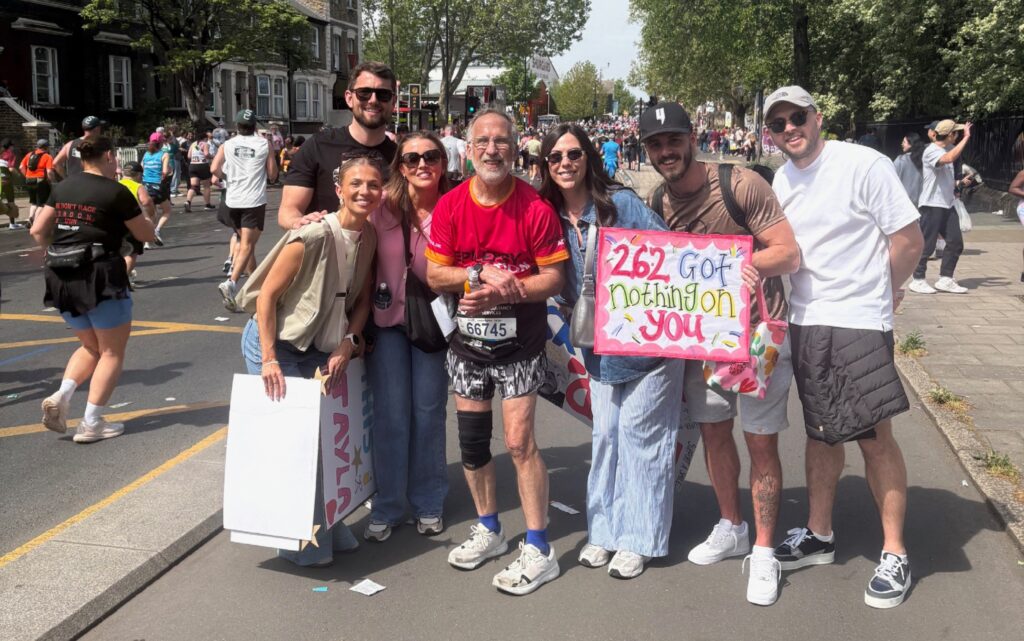
But also fortunately, I had crashed in front of six spectators who had come cheer for another runner, and they came to my rescue. They were my angels, able to physically lift me off the ground, support me, offer me orange slices and a bottle of water. Above this article is their picture with me, and their concern and support at that moment was heaven-sent. I was also near a fire department rescue team, who came over to assess my ability to continue. Amazingly, the ankle seemed good enough to bear weight and walk upon. After at least 10 minutes after my crash, I was able to resume the course.
But the crash and the stoppage had really changed everything. After trying to run again, I felt occasional ankle and knee weakness, and I didn’t feel confident getting back into extended stretches of running. My legs, with a third of a marathon behind me, had stiffened up and I couldn’t restart with any speed or confidence. I soon realized I would be walking much of the remaining 18 miles.
And so, I hit the half-marathon mark in slightly more than three hours, and the second half would only get worse. There’s a particular downward spiral of the spirit for a runner who’s underperforming with no hope for improvement on the horizon – you feel depressed, making it even harder to restart and sustain, and the walking or shuffling depresses you even more. You hit an uphill adversity, and you’re quick to default to the walk. And believe me, I was now terrified about discarded water bottles.
So, it was with a mix of embarrassment and exhilaration that I ran-walked to the 26-mile marker, right near Buckingham Palace. The finish on the mall is iconic, and I was determined to at least try to jog/run in to finish. I almost did ugly crying the last 100 yards, but held it together to deceptively finish in something that looked somewhat normal. Six hours, 49 minutes; 57,000th place out of 60,000 runners. Egads; I originally had hopes of finishing in less than five hours.
That’s life
On a tour of London the next day, some new acquaintances who were with me bluntly asked, “Why do you run marathons?”
After Sunday, the answer didn’t seem to be, “Because I’m a sane person.” I think my best answer is that there are so many experiences and challenges in each and every marathon that teach you something about life, like coping with training discipline or managing disappointment. It’s committing to do a hard thing and then persevering when life throws a water bottle in your path.
A consequential life is one that commits to doing hard things, which often brings challenging surprises. For some, it’s choosing a difficult profession, like caring for sick people, or going all out to make the final days of a terminal patient’s life better, or championing the use of IT in healthcare, even when it’s an uphill battle. Or you raise kids when they’re difficult and don’t return love to you. Or you’re supporting aged parents who have increasingly challenging needs. Or your career gets blown apart by a layoff or other termination. The list goes on – you get the idea. As Jesus noted, “In this world, you will have trouble … “
Our character is defined by how we persevere and attempt to overcome these certain-to-happen challenges. The easy route is to bail out, look for the cushy path, avoid the pain at all costs. But life isn’t like that. The marathon isn’t like that. Things don’t happen according to the plan you optimistically draw out on a sofa in your living room. That’s where you don’t factor in something unexpected, like random water bottles.
That’s why I've run marathons; they teach me, and re-emphasize within me, the kind of life I want to live, the kind of person I want to be. It’s facing the certain challenges that lie ahead with all the courage I can muster. And drawing on the blessings of those angels who offer orange slices, a (safe) bottle of water, hands to get you to your feet again, a shoulder for support, and words of encouragement to propel you forward again.
Our CEO, Mitchell Josephson, often uses these optimistic words above his signature in emails -- “To much good.” In your personal marathons of life, work toward that lofty goal. And never, ever give up. Lean on your angels and be borne up, to do much good.
Fred Bazzoli is the Editor in Chief of Health Data Management.