
How PBM opacity hides where the drug money goes
Organizations that want to manage pharmacy spending can use technology tools to gain insight into this often invisible cost center.

A patient's specialty medication may be reimbursed to the dispensing pharmacy at one amount, billed to the health plan or employer at another and leave the patient responsible for yet another amount. Many plan sponsors cannot independently see or reconstruct the full gap between those amounts or where every component of the difference ends up.
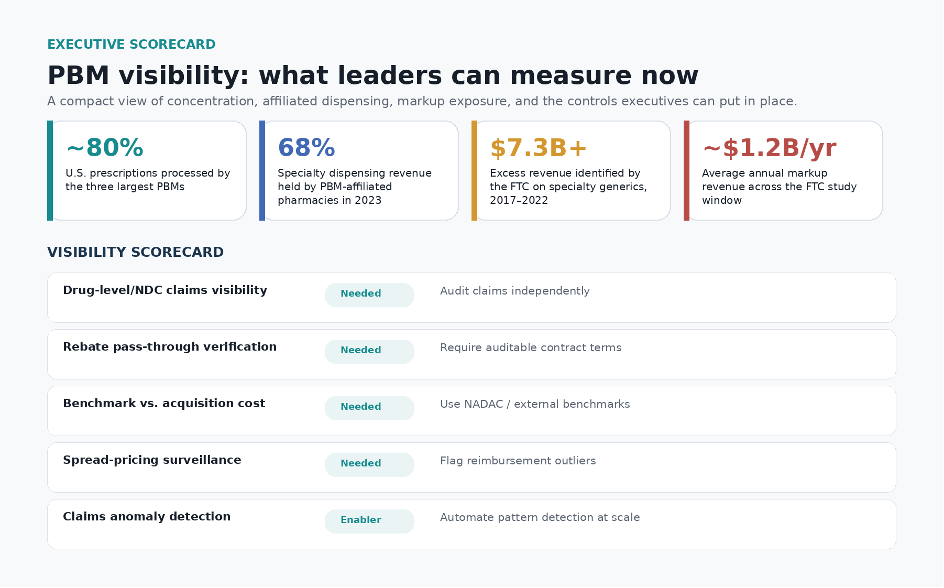
That gap is not a rounding error. According to an FTC investigation, the three largest pharmacy benefit managers and their affiliated specialty pharmacies generated more than $7.3 billion in dispensing revenue above estimated acquisition cost, as measured by the National Average Drug Acquisition Cost (NADAC), between 2017 and 2022 by marking up specialty generic drugs, in some cases by hundreds or even thousands of percent.
Rather than remaining flat, PBM-affiliated pharmacy dispensing revenue greater than NADAC on the specialty generic drugs analyzed increased from approximately $522 million in 2017 to $2.1 billion in 2021, a compound annual growth rate of more than 42 percent. The FTC report noted limitations in the 2022 data, but the direction through 2021 was unmistakable – the amount grew sharply over the study period.
For healthcare executives, the more useful way to think about this is as a visibility problem rather than a pricing problem. A CEO cannot manage a cost center that is invisible. A CFO cannot forecast pharmacy spend built on numbers the vendor controls.
The markup could remain difficult for payers, employers and patients to independently verify for years, not because the information was literally hidden in a vault, but because many plan sponsors lacked some combination of data access, contractual rights and analytical infrastructure needed to reconstruct it.
Three companies control most of the market
Pharmacy benefit managers sit between drug manufacturers, pharmacies, health plans and patients, and three companies dominate that position. Caremark (CVS), Express Scripts and OptumRx processed nearly 80 percent of the roughly 6.6 billion prescriptions dispensed in the United States in 2023.
Each of these three PBMs is now vertically integrated with a major health insurer and its own specialty pharmacy. That integration matters because it means the entity negotiating the price, the entity dispensing the drug, and the entity collecting the rebate can all be the same corporate family. The FTC found that PBM-affiliated pharmacies' share of specialty drug dispensing revenue grew from 54 percent in 2016 to 68 percent in 2023.
Rebates add a second layer of opacity to the markup. Manufacturers pay PBMs rebates and other remuneration under contractual arrangements that can be tied to drug utilization and pricing. Historically, PBM contracts varied in how much of those payments was passed through to the health plan or employer that hired them, and a GAO report found that PBMs may retain a portion of rebates depending on the arrangement.
That framework is now changing. The 2026 law requires affected PBM arrangements serving group health plans – after its relevant provisions take effect – to remit 100 percent of specified rebates, fees, alternative discounts and other remuneration tied to drug utilization or spending to the plan or insurer, along with new disclosure and audit rights. Those provisions generally apply to plan years beginning on or after Aug. 3, 2028, which means Jan. 1, 2029, for calendar-year plans.
Where rebate arrangements are structured as a percentage of list price, a higher-list-price drug can generate a larger dollar rebate than a lower-list-price alternative. The FTC documented this incentive concern in markets including insulin, alleging that high rebates helped favor higher-list-price products over lower-list-price alternatives. That creates a potential financial incentive that has nothing to do with which drug delivers better value for the patient.
Depending on contract terms, employers and health plans may still be unable to independently verify what share of the rebate they received, because underlying contract terms and drug-level data may remain proprietary to the PBM.
The result can be a system in which the employer or payer whose money is ultimately at stake has less visibility into the true flow of funds than the intermediary negotiating on its behalf.
Closing the visibility gap
Market concentration, vertical integration, rebate opacity and specialty markup are really four versions of the same problem – a payer's inability to see what it is being charged. Health systems, employers and payers cannot manage a cost they cannot see, and PBM contracts can make independent verification difficult.
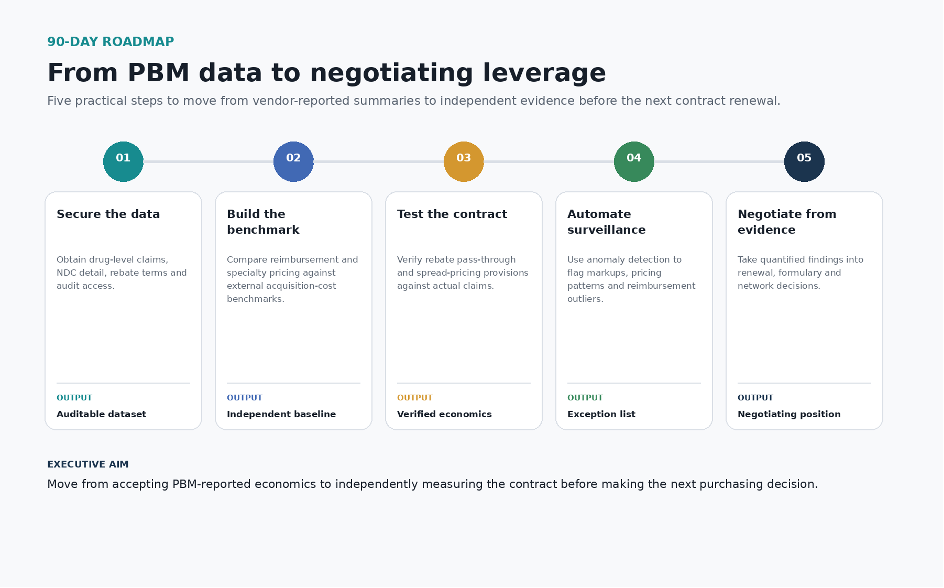
This is squarely within reach for healthcare executives who treat it as an enterprise data governance priority rather than a routine vendor relationship. Auditing PBM claims data at the drug and NDC level, benchmarking specialty pharmacy reimbursement against acquisition cos, and building independent formulary analytics are all achievable with the right investment and the right executive sponsorship.
Many organizations have not made that investment because the PBM relationship has historically been treated as a procurement decision rather than a strategic one.
Closing this visibility gap does not require waiting for a PBM to change how it reports data. AI- and machine-learning-based anomaly detection tools can analyze claims at scale and flag unusual markups, pricing patterns and reimbursement outliers for further review.
A systematic review of machine-learning approaches to health insurance fraud detection found a substantial body of research applying these methods to claims-related anomaly and fraud detection. The FTC's own methodology did not use AI; it compared reimbursement data with a public benchmark such as NADAC to identify outliers and margins. AI tools can automate analogous pattern-detection work at scale, as long as they have access to the necessary data.
For a healthcare executive, the opportunity is straightforward – apply the same class of tool used to catch internal billing errors and fraud to the claims data coming back from the PBM.
Claims data may already sit in an organization's claims warehouse, but claims alone do not reveal every component of PBM economics. Independent analysis may also require contract terms, rebate and remuneration data, post-adjudication adjustments, and external acquisition-cost benchmarks. What has been missing in many organizations is the combination of access, contractual rights, analytical capability and executive commitment to analyze the relationship independently instead of relying only on the vendor's own summary.
Priorities for healthcare executives
Regulatory pressure on PBMs is intensifying, but regulation alone will not close a data visibility gap that health systems and employers can start closing today.
Congress enacted a new federal law in February that includes PBM transparency, rebate pass-through, disclosure and audit requirements. The FTC reached a settlement with Express Scripts this past February requiring significant changes to its business practices, including greater transparency. And in July, the FTC reached a similar settlement with Caremark that includes increased transparency and delinking PBM fees from drug list prices.
The PBM industry contests some of the broader conclusions drawn from regulatory scrutiny of the sector. Its primary industry group argues that the market has already moved substantially toward rebate pass-through and that PBMs deliver broader cost savings for plan sponsors. Those arguments do not negate the FTC's documented findings on the specialty generic drugs it analyzed, but they are relevant when considering how broadly those findings should be generalized.
The organizations that build independent claims analytics now will be the ones positioned to negotiate from evidence rather than trust when the next PBM contract comes up for renewal.
The markup was never really hidden. It was sitting in data that many organizations outside the PBM had not had the access, contractual rights, or analytical capability to fully see.
Visibility is the first problem. The next is control. Part two of this series looks at why a growing number of health systems are responding by bringing specialty pharmacy infrastructure – and the data behind it – inside their own organizations.
Julia Rehman, DHA, FACHE, FACHDM, is founder and chief operating officer of Kota Kompany LLC.