Running a race, experiencing a memory in Tokyo
Surviving a marathon in Japan’s top city was made more special by the many people who cheerfully supported the event and its 40,000 runners.
I’m just back from a trip to Japan and participating in the Tokyo Marathon on March 1. And while I generally don’t like writers who tell you about a trip they’ve taken and an experience they’ve had, well, that’s just what I’m going to do – I’m taking a mulligan because of jet lag.
I’ll get my performance out of the way quickly. My training during this past Chicago winter has been spotty, and I suffered two bad colds that set me back. And then, the weather in Tokyo was unseasonably warm, in the mid to high 60s during the race, mixed with high humidity and strong sun. I’m not particularly proud that it took me six-plus hours to finish, but I did complete the distance, which was my bottom-line goal.
And I didn’t miss the experience, which is easy to do when you overly focus on performance. I stopped to take pictures along the course, enjoyed some of the on-course culture and entertainment, and just absorbed as much as I could.
An army of volunteers
But of most relevance to you, and of significance to me, was the incredible volunteerism that makes the Tokyo Marathon special.
In Tokyo, an estimated 11,000 people coming together to make the marathon happen. They include planners, expo staff, people with signs directing runners on race day, people staffing staging areas, clothing drop-off areas, starting “corral” managers, aid station staffing, medical staffing, people managing traffic, those managing runner transportation, toilet station areas, finish line direction and logistics, and more people that are behind the scenes.
All these individuals in countless roles support a race with 40,000 participants – keeping people moving, coordinated, happy and, most importantly, safe. The marathon specifically focuses attention on its volunteer program. Literature proclaims “Your smile unites the world. Helpful Tokyo Marathon volunteers are full of hospitality and a symbol of the Tokyo Marathon. They support runners, as well as the people involved in the event, including spectators and staffs, from the start line all the way to the finish with friendly smiles.” The race's foundation operates an official volunteer club with the tagline that “a volunteer is an entertainer... where anyone in any place can take part and give support with pride and to foster sports volunteers.”
For example, for this marathon, there were 15 planned aid stations serving both water and a replenishment drink called Pocari Sweat.& Each station had tables spanning a couple hundred feet in length, with volunteers directing runners, putting out cups, pouring liquid, shuttling boxes, gathering discarded cups and sorting refuse, and more. I’d estimate there were at least 100 volunteers at each station.
Then, there’s the porta-potties. In addition to hundreds of units in the staging area at the starting complex, there were another 15 areas or so along the course, each with dozens of units. Each was highly organized (I know – I stopped to use one just before the 12-mile mark). Volunteers direct you off the course, into lines, toward designated women’s and men’s stalls (some of the men’s were open-door urinals, which I guess saves on time and money, but enable sufficient privacy for the task at hand). And then other volunteers direct runners back to the course.
Serving with joy and passion
It wasn’t just the number of volunteers that impressed me. It was their passion and commitment and buy-in and support of runners as individuals. They weren’t just booking time and getting out as soon as they were done – they were completely bought in and enthused about their assigned task.
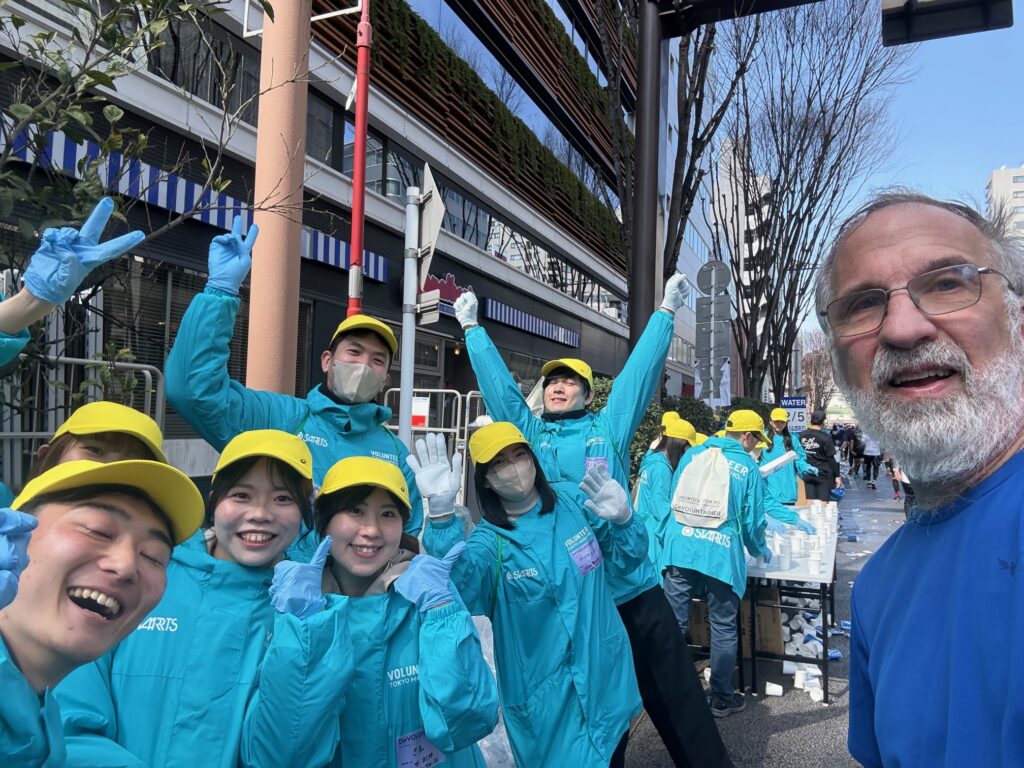
The picture at the top of this newsletter is just one example and my favorite picture from the race. These were young people at the first table of one of the water stations. By the time I had arrived, they had long since run out of water and were just directing runners to go to tables further down the line. They were lively and animated (this was at least four hours after the start of the race). I asked if I could take a picture, and you can see the response. They truly were enjoying the day, and their chance to be a part of it.
I’m not sure if this level of passion to serve is cultural or based on a difference I don’t understand. The city is truly proud of this event, one of the seven major marathons in the world. Without this massive support from volunteers, there is no sustainable marathon – for example, insufficient staff or fewer aid stations can create a huge health crisis endangering runners. Having great directors and proven logistics is nice, but that alone does not result in a successful race.
Inculcating importance into each person’s role was obvious in Tokyo. This is crucial if you’re going to get someone to commit to long hours or several days of service. I don’t think anyone gets really excited about directing traffic around the men’s urinals at mile-stop 12 as achieving a life-fulfilling goal, but the importance of each person’s role in the success of the marathon obviously has been communicated to each and every volunteer.
I thought of the importance of this in any organization of which we’re a part, whether it be a healthcare organization, civic group or other community service group. The depth of the communication of the mission, and each person’s pivotal role in it, is so crucial to how any organization self-sustains and how well it lives out that mission in its interactions with the wider world.
A meaningful experience
And it makes a difference. I’ll end with an experience I had after finishing the marathon, well after most of the runners had already completed the course and departed. Picture this – once you cross the finish line and get your medal, you get a couple bottles of liquid to hydrate, and then walk through several stations where you get various foods or other handouts. By the time I’m hobbling through this area, literally thousands of runners have gone before me – I’m one of only a few stragglers as the sun is finally low and a cool breeze can be felt.
Your final task is to pick up the bag of clothes or supplies that you dropped off at the start, at least an hour before the start of the race. Already, thousands of runners have already cycled through and picked up their bag. There are five separate locations for bag pickups, and some are already being broken down because everything’s been distributed to the earlier runners. They’re closing up shop.
But many of the volunteers aren't done. They are on each side of your path, perhaps 10 on each side, and they’re clapping as you approach and walk through their gauntlet, hailing you individually. They’re smiling and waving and calling out, “Congratulations!” like you’re the most important finisher in the race.
This happens at each of the five bag distribution stations, even after I've received my drop-off bag. More claps, more smiles, from volunteers that look like they’ve just started their day and are thrilled to celebrate with you.
By the time I reach the last one, I’m nearly in tears, a bit embarrassed but so appreciative to experience these exuberant volunteers in this special way. A very rough day has been completely reversed by these friendly, excited smiles.
To each and every one of you who volunteered in Tokyo, I’ll say, “arigato,” or more accurately, “kokorokara kansha shimasu,” which I hope means, “Thank you from the bottom of my heart.” You made my experience rich and special. I hope your story will instruct and inspire us as we provide service to others in our lives here.
Fred Bazzoli is the Editor in Chief of Health Data Management.