Why healthcare data represents more than information
It is a patient’s story, segmented into innumerable pieces that must be brought together to provide optimal care.
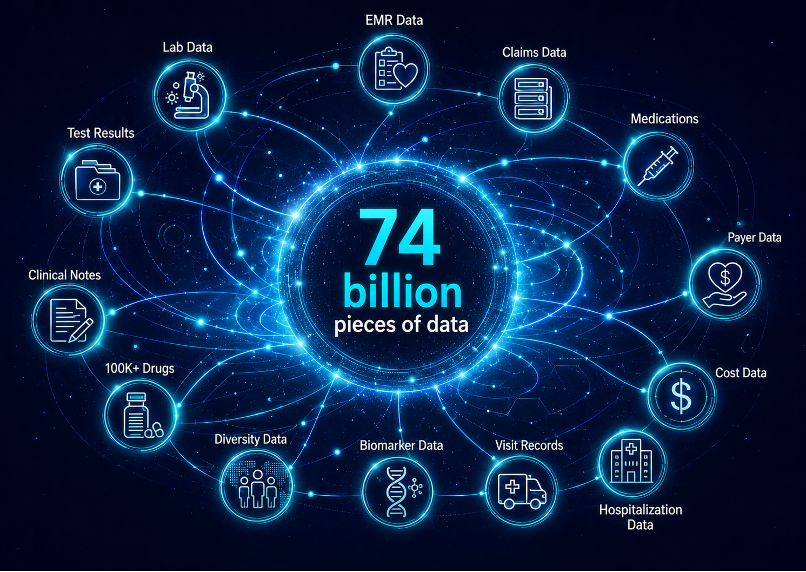
In healthcare, we often speak in familiar operational language – claims, lab results, EMR data, clinical notes, test results, medications, eligibility files, cost data, payer data, visit records, hospitalization data, biomarkers, drug codes and member IDs.
To many outside the field, these may sound like disconnected technical terms. To those who work in health data management, they represent something much deeper. Every record is a piece of a patient’s story, and every data point has the potential to influence care, access, quality, cost and trust.
The visual accompanying this article uses the scale of 74 billion pieces of data to illustrate the magnitude of information flowing through modern healthcare ecosystems.
Whether looking at one health plan, one delivery network, one pharmacy benefit process or the broader industry, the message is clear – healthcare is no longer managing data as a secondary administrative activity. Data is now part of the clinical, operational, financial and ethical foundation of healthcare.
Deep data to manage
Healthcare data is different from many other types of organizational data because it is deeply contextual.
A medication record is not simply a product transaction. It may represent a patient’s adherence challenge, a provider’s treatment decision, a payer’s coverage rule, a pharmacy claim, a potential safety concern or a quality-measure event.
Additionally, a lab result is not just a number. It may indicate disease progression, treatment effectiveness, care gaps or the need for urgent follow-up.
A denied claim is not only a payment issue. It may create friction in access, delay treatment or expose gaps in benefit design and communication.
That is why awareness matters. When data professionals, analysts, quality leaders, compliance teams, informatics leaders and operational teams handle healthcare data, they are not merely handling files. They are handling information that can shape decisions.
Those decisions may affect how care teams prioritize outreach, how organizations measure performance, how members understand coverage, how leaders allocate resources, and how regulators evaluate accountability.
Taking on a new mindset
The most important shift is moving from a volume mindset to a stewardship mindset.
A volume mindset asks, “How much data do we have?” A stewardship mindset asks, “What does this data mean, where did it come from, how reliable is it, who can access it and what decision will it influence?” This difference is not academic. It determines whether data becomes insight or noise.
Data quality must also be viewed as a healthcare quality issue. Incomplete demographic information can distort equity analysis. Incorrect dates can affect timeliness measures. Mapping errors between systems can change reporting outcomes. Missing clinical context can lead to false conclusions. Poorly maintained provider, drug or member identifiers can break the chain of understanding across systems.
In a healthcare environment, a data defect is rarely just a technical defect. It may become a reporting defect, an operational defect, a compliance concern or a patient-experience issue.
This is especially important as healthcare organizations increase their use of automation, analytics and artificial intelligence. AI does not remove the need for strong data management; it increases the need. Predictive models, dashboards, quality algorithms and generative AI tools can only be as responsible as the data foundations behind them. When data is incomplete, biased, outdated, poorly linked or misunderstood, technology can amplify the problem with speed and confidence.
Data awareness
Healthcare data awareness therefore begins with simple but powerful questions.
What population does this data represent? What population might be missing? What definition is being used? Has the data been validated against a trusted source? Are we using the right time period? Is the linkage between systems reliable? Are we applying the minimum necessary standard? Are we using the data for a purpose that benefits patients, members, providers and the healthcare system?
For health data management professionals, the work is not only technical. It is also interpretive, ethical and strategic. We translate raw information into meaning. We protect sensitive information while enabling appropriate use. We help organizations understand not only what the data says, but also what it does not say. That humility is essential.
Awareness also requires shared accountability. Data governance cannot live only with one data owner, one analytics team or one compliance function. It must be embedded into daily work – requirements, mapping, testing, validation, reporting, access reviews and operational decision-making. Every handoff is a chance to preserve meaning or introduce risk.
As healthcare continues to evolve, the organizations that succeed will not simply be those with the largest data assets. They will be the organizations that treat data as a trusted responsibility. The data we handle may be digital, but its impact is human. Behind every field, file, and figure is a person whose care journey deserves accuracy, context, privacy, and respect.
Sravan Kumar Nidiganti, MBA, LSSGB, MACHE, FACHDM is the leader of enterprise quality management, benefits and clinical operations for CVS Health.