
Why it’s difficult to move past deployment to adoption
Implementation is only the start; more groundwork is needed to achieve the missing layer between innovation and outcomes.
Healthcare organizations have never had access to more sophisticated technologies. Artificial intelligence, predictive analytics, remote monitoring platforms, digital therapeutics and clinical decision support tools all promise better outcomes, greater efficiency and improved experiences for patients and care teams alike.
But despite remarkable advances in capability, many organizations continue to encounter a familiar frustration. Technologies that function exactly as intended often fail to deliver the impact that leaders expected.
Utilization rates plateau. Pilot programs generate enthusiasm but struggle to scale. Features are implemented, training is completed and dashboards show successful deployment, yet the behaviors necessary to create meaningful value never fully materialize.
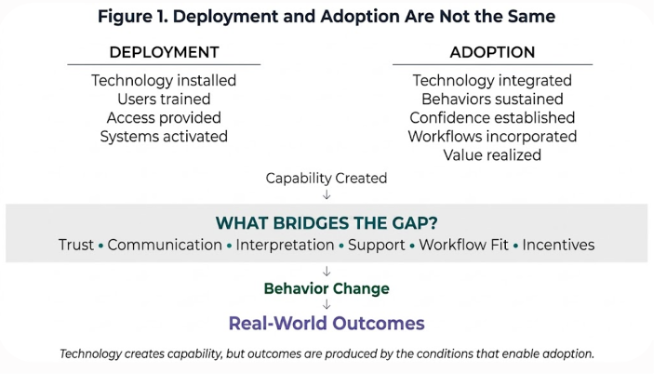
One reason for this disconnect lies in a subtle but important misunderstanding. Deployment and adoption are frequently treated as though they are interchangeable. They are not.
Success metrics tell only part of the story
Implementation efforts are typically measured by milestones. Did the integration go live? Were users trained? Were licenses activated? Was the system deployed on schedule?
These are important questions, but they describe implementation rather than adoption.
Adoption occurs when people willingly and consistently incorporate new capabilities into the way they think, decide and work. It reflects behavior, not access. That distinction matters because organizations can achieve technical success without achieving operational success.
This helps explain why many innovations that appear successful on paper struggle to generate lasting impact. The technology itself may be functioning perfectly while the conditions surrounding its use quietly undermine its potential.
The missing layer between capability and outcomes
Healthcare leaders naturally focus on capabilities because capabilities are visible. They can be purchased, implemented and measured. What is less visible are the conditions that determine whether those capabilities become meaningful in practice.
Clinicians and patients do not experience technology in isolation. They experience uncertainty, competing priorities, workflow realities, communication gaps and varying levels of confidence.
A tool that introduces additional complexity or ambiguity may struggle to gain traction even when the underlying science or engineering is sound.
Likewise, a highly capable platform may fail to achieve widespread use if individuals are unclear about how it fits into their daily routines, lack confidence in interpreting information or perceive more friction than value.
Ken Poray, a Fellow of the American College of Health Data Management and leader of the AI Community of Practice, has described this challenge as the “engine vs. strategy trap.” Technology itself is the engine, but purchasing the engine is not the same thing as designing the systems and workflows that enable it to create value.
Why usage often lags implementation
When leaders encounter disappointing utilization, the instinct is often to focus on training or communication. While both are important, the problem frequently runs deeper.
Low adoption rarely stems from a single cause. More often, it reflects the combined influence of numerous small barriers. Workflow friction, uncertainty around interpretation, competing priorities, insufficient support, misaligned incentives and added cognitive burden may each seem insignificant in isolation. Collectively, however, they can prevent even promising innovations from becoming part of everyday practice.
This is one reason why two organizations using the same technology can experience dramatically different results. The difference frequently lies not in the tool itself, but in the environment surrounding its use.
A different way to think about innovation
As healthcare organizations continue to invest in increasingly sophisticated capabilities, understanding the distinction between deployment and adoption may prove to be one of the defining leadership challenges of the next decade.
Perhaps one of the most important questions leaders can ask is not whether a technology has been implemented, but whether the conditions necessary for adoption have been intentionally created. Because implementation is only the beginning. Real impact occurs when innovations become part of everyday behavior and, ultimately, part of everyday practice.
Kerry Flagg, MS, FACHDM, is head of healthcare provider marketing and commercialization at TruDiagnostic and previously served as chief marketing officer and executive committee member at Regenexx.