Digital readiness in healthcare begins with data readiness
There’s a risk that organizations will try to skip steps to implement AI and advanced analytics, without solving data fragmentation issues.

Healthcare organizations are investing heavily in artificial intelligence, predictive analytics, automation, digital front doors, remote monitoring and smart hospital infrastructure.
However, many organizations continue to struggle with a more foundational issue – digital readiness cannot exist without data readiness.
The World Health Organization's Global Strategy on Digital Health emphasizes that digital health must be supported by strong governance, national strategies, interoperability, standards and the appropriate use of health data.
This is an important reminder for healthcare leaders – digital transformation is not simply the adoption of new technologies. It is the ability to create trusted, usable and well-governed information that supports better clinical, operational, financial and strategic decisions.
Across healthcare systems, leaders are pursuing AI and digital transformation while still managing fragmented data environments, inconsistent reporting structures, disconnected workflows and legacy governance models. The result is often a gap between technological ambition and operational reality. This is where data governance and data management become essential.
A foundation that most organizations skip
Healthcare data now exists across electronic medical records, laboratory systems, radiology platforms, claims systems, ERP systems, workforce platforms, wearable devices, registries and national reporting infrastructures. Without a structured governance framework, organizations risk inconsistent definitions, duplicate reporting, poor data lineage, weak accountability and reduced trust in analytics outputs.
The OECD Recommendation on Health Data Governance highlights the importance of privacy, transparency, data quality, security, interoperability and public trust in the use of health data. These principles are especially relevant as healthcare organizations move toward AI-enabled decision-making and more complex data-sharing environments.
One of the most common misconceptions in healthcare transformation is that technology alone creates maturity. In reality, organizations become digitally mature when they establish governance structures that define accountability, ownership, quality standards, interoperability requirements, access controls and stewardship processes across the enterprise.
Strong governance is not a barrier to innovation. It is what makes innovation sustainable.
The digital readiness ladder
Organizations with mature governance frameworks are better positioned to improve operational decision-making through standardized KPIs, support AI and advanced analytics with higher-quality datasets, strengthen regulatory and audit readiness, reduce duplicate reporting, improve patient safety through more reliable information, and increase executive confidence in enterprise data.
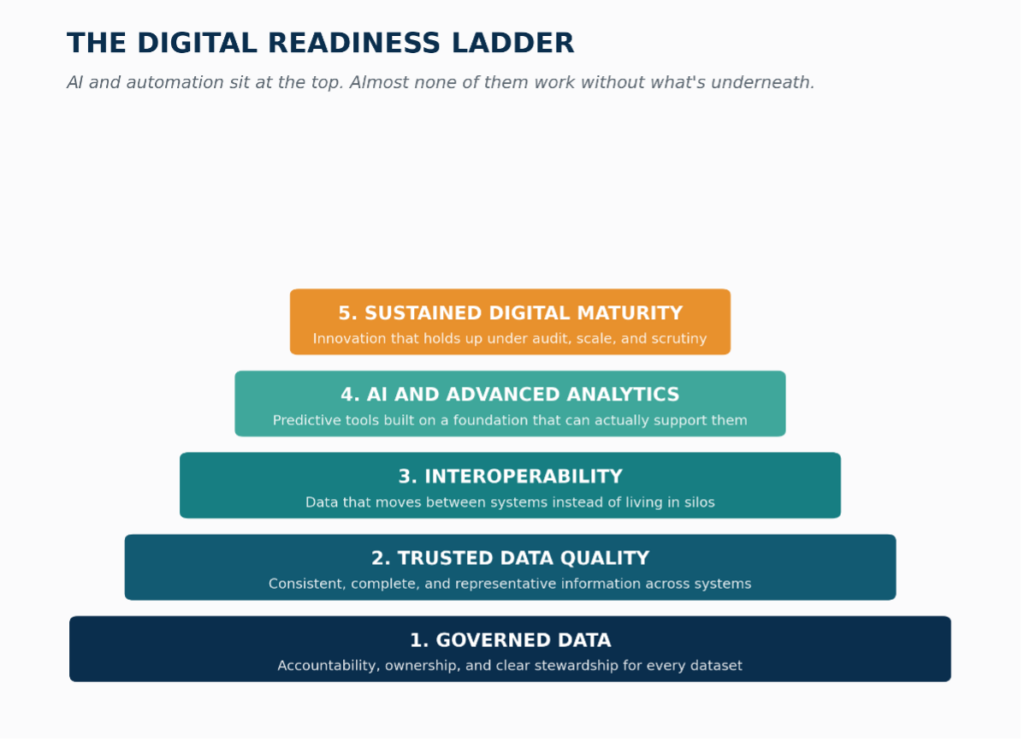
Each rung depends on the one beneath it. Organizations that try to skip straight to AI and advanced analytics without governed, trusted and interoperable data are not actually more digitally mature. They have simply digitized their existing fragmentation.

The human dimension
Data governance is not solely an IT responsibility. Sustainable transformation requires executive sponsorship, clinical engagement, operational alignment and organizational accountability.
The National Academy of Medicine has emphasized that health AI should be developed and deployed in ways that are safe, effective, equitable, transparent and accountable. These principles are difficult to achieve when the underlying data environment is fragmented or poorly governed.
As healthcare systems continue to adopt AI, the importance of data management will only increase. AI systems depend on the quality, consistency, completeness and representativeness of the data used to train, validate and operate them. Poor data quality does not simply create reporting problems; it can create operational risk, algorithmic bias, patient safety concerns and loss of trust.
The NIST Artificial Intelligence Risk Management Framework reinforces the need for organizations to govern, map, measure and manage AI risks throughout the lifecycle. For healthcare organizations, this means AI governance cannot be separated from data governance. The reliability of an AI model begins with the reliability of the data environment that supports it.
Priorities for health data management leaders
Ask the harder question first. Before approving another AI pilot, ask whether the organization is truly digitally advanced or has simply digitized its existing fragmentation.
Fund governance like it is infrastructure. Accountability, ownership and stewardship processes deserve the same budget discipline as the technology built on top of them.
Make data quality a named owner's job. Standardized definitions and consistent data lineage cannot depend on informal habits or a single overworked analyst.
Treat AI governance and data governance as one program. A model is only as trustworthy as the data pipeline feeding it, so the two cannot be managed on separate tracks.
Looking ahead
The future of healthcare transformation will not be determined solely by which organization adopts the most technology. It will be determined by which ones build the strongest foundations for trusted data, responsible governance and operationally integrated decision-making.
Digital readiness begins long before AI deployment. It begins with governance maturity, data integrity and the organizational discipline to treat data as a strategic asset rather than a byproduct of operations.
Dr. Julia Rehman, DHA, FACHE, FACHDM, is an Executive Fellow of the American College of Health Data Management.