What the Scott County HIV outbreak can teach us
To head off the outbreak, organizations needed to better connect information that already existed. Their failure exacerbated the emergency.

In November 2014, an alert disease intervention specialist in rural Indiana noticed something odd. HIV, historically almost nonexistent in Scott County, was suddenly appearing again and again.
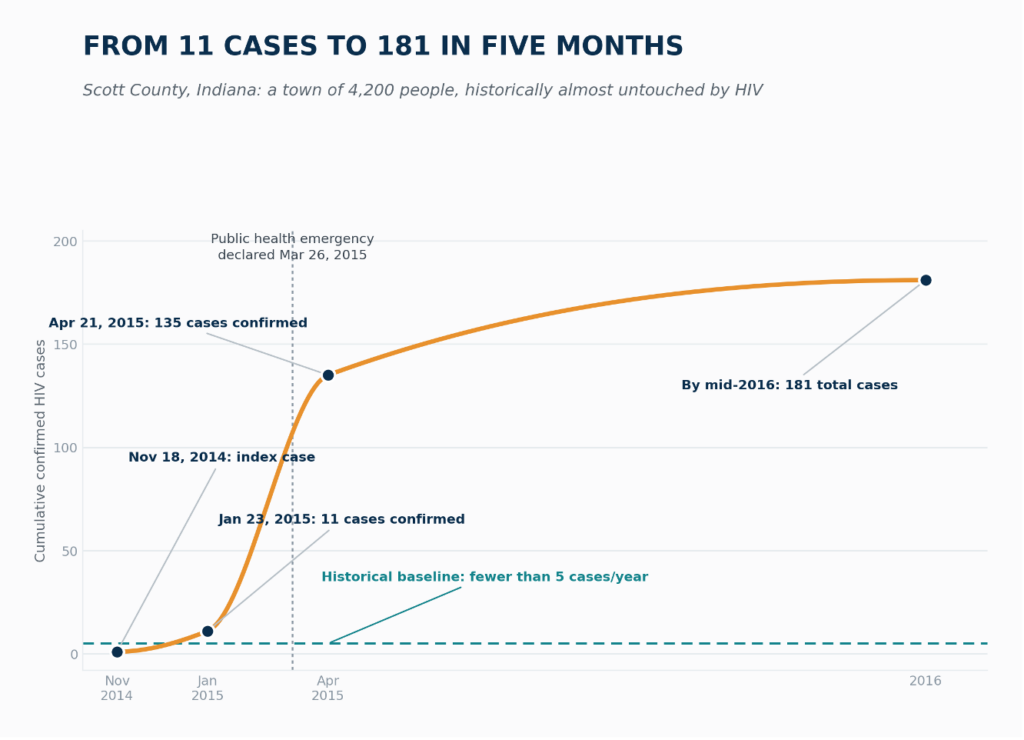
By January 2015, Indiana's health department had confirmed 11 cases in a community of roughly 4,200 people that had reported fewer than five HIV diagnoses a year for a decade. Three months later, that number had climbed to 135. By the time the outbreak was brought under control, 181 residents had been diagnosed.
This was not a new or exotic pathogen. HIV is one of the most studied viruses in medicine. The failure in Scott County was not scientific. It was a failure to see.
A risk that should have been caught sooner
The warning signs were not subtle, in hindsight. A hepatitis C outbreak tied to injection drug use had already hit the region in 2010 and 2011. Local experts recommended a syringe services program as early as 2008. The recommendation went unheeded for years.
Meanwhile, the region's only dedicated HIV testing provider closed in 2013 after state funding cuts, likely delaying diagnosis of the very first case.
None of this required predictive modeling to catch. It required connecting information that already existed -- a prior outbreak, an expert recommendation, a service closure and a rising case count, all sitting in different systems, owned by different agencies, none of them talking to each other.
When the data streams finally connected
Once the outbreak was declared a public health emergency, the response changed. The CDC brought in a Hadoop-based analytics platform developed by a defense-sector contractor and repurposed for public health to fuse disparate data sources, including case interviews, treatment records and syringe-sharing networks, into a single operational picture.
Separately, researchers layered genomic sequencing on top of traditional contact-tracing interviews. The interviews alone produced one map of the outbreak. The viral genetics told a different, more complete story. Seven distinct viral mutations revealed clusters of transmission that interviews had missed entirely, including people who had never been connected through personal networks.
Two data sources. Two different pictures. Only together did they show the real shape of the crisis.
Why this is an enterprise story
For health system leaders, Scott County is not simply a historical case study in rural public health. It is a preview of how any organization can miss a slow-building risk when information lives in silos.
A CEO sees it as a question of community trust and reputational exposure. A CFO sees the cost of a delayed response mapped against the cost of sustained surveillance. A CIO or chief digital officer sees a governance failure, because the data existed, but no one had built the pipes to move it to the people who needed it. A CMO sees a workforce and a community that paid the price for that gap in visibility.
The lesson generalizes well beyond infectious diseases. Any organization sitting on fragmented operational, clinical and community data is one slow-moving signal away from its own version of Scott County.

Priorities for health data leaders
Treat vulnerability assessments as living documents, not archives. National researchers had already identified counties most vulnerable to exactly this kind of outbreak, using measurable indicators like poverty, unemployment and drug overdose rates. That data existed before Scott County's outbreak began. Leaders should ensure that similar vulnerability data is continuously monitored, not filed away.
Fuse behavioral, clinical and genomic data by default, not only in a crisis. The combination of interview data and viral sequencing revealed transmission chains neither source could show alone. Build that kind of data fusion into ongoing surveillance, not just emergency response.
Build governance that can act on a known signal without a political trigger. A syringe services program was recommended years before it was authorized. Data-driven recommendations need governance structures empowered to act on them before, not after, a crisis forces the issue.
Treat public health infrastructure as a data asset. The closure of the region's only HIV testing site was a budget decision made without full visibility into its surveillance value. Access points for testing and care are also access points for the data that keeps a community safe.
Looking ahead
Scott County's outbreak ended not because a new treatment was discovered, but because fragmented information was finally connected, although it was too late to prevent the harm that had already occurred.
The Quintuple Aim asks health leaders to improve outcomes, reduce the burden of care and close equity gaps in access. Scott County shows what happens when the data needed to do all three exists, but it isn't connected until the crisis is already underway.
The organizations best positioned for the next slow-building risk will not be the ones with the most data. They will be the ones whose data can already talk to itself before anyone has to ask it to.
Dr. Julia Rehman, DHA, FACHE, FACHDM, is an Executive Fellow of the American College of Health Data Management.