Fibromyalgia care needs more than a prescription
The first of three articles examines the evidence for treatment and the financing gap around coordinated fibromyalgia care.

Fibromyalgia is a common chronic pain condition, affecting approximately 2% of the population in estimates cited by European rheumatology guidance. It is characterized by widespread pain accompanied by fatigue, sleep disturbance and cognitive symptoms, and it reduces function, productivity, and quality of life. For safety-net providers, it also presents a familiar dilemma: supporting a comprehensive care plan takes more than paying for a prescription.
This article is the first in a three-part series. It describes clinical and economic problems. Part 2 examines whether the 340B Drug Pricing Program can lawfully help finance a better care model, and Part 3 sets out the design and measurement of a multidisciplinary fibromyalgia service line.
The author is co-founder and chairman of Rapha Digital AI, whose work includes AI-enabled tools related to the 340B Drug Pricing Program. That relationship is relevant to this series’ financing discussion. The article evaluates no commercial product, and covered entities considering a 340B-supported program should obtain legal and compliance review.
A limited medication pathway
Pregabalin, duloxetine and milnacipran have long carried U.S. Food and Drug Administration (FDA) approval for fibromyalgia, and generic versions are available. The FDA approved the first generics of pregabalin in 2019. The treatment landscape has since changed. In August 2025, the FDA approved Tonmya, a sublingual cyclobenzaprine formulation for adults with fibromyalgia. That approval needs to be distinguished from off-label use of older oral cyclobenzaprine formulations.
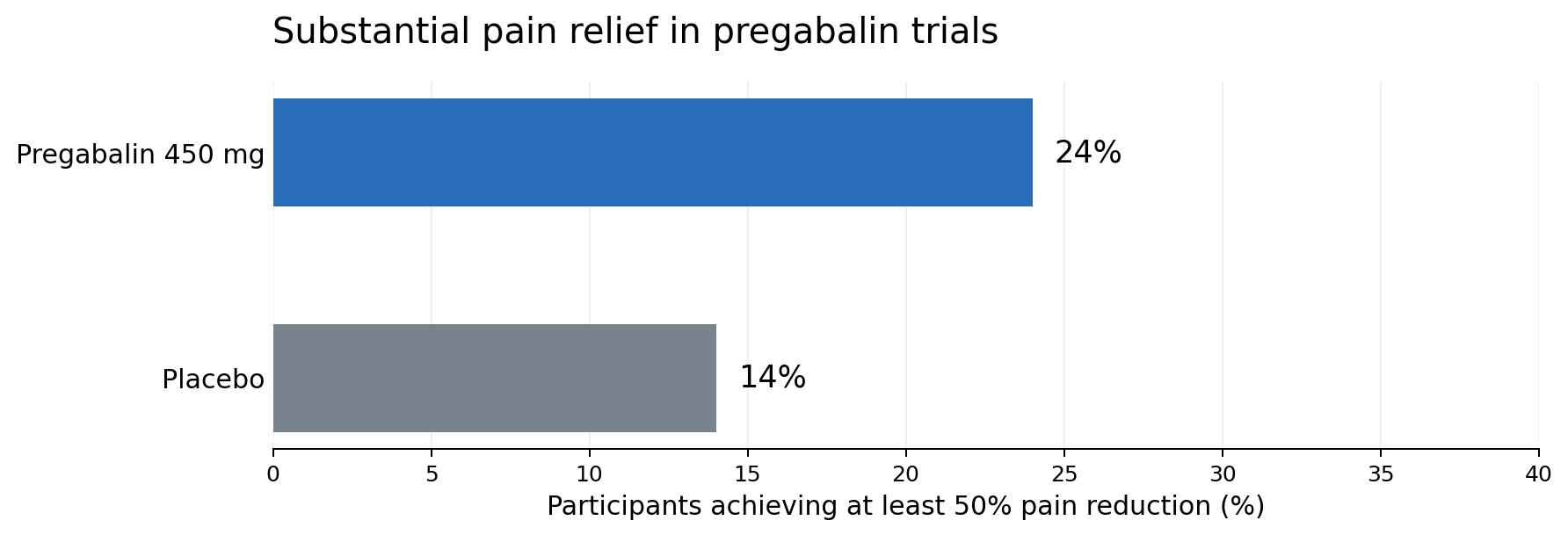
A 2025 overview of 21 Cochrane reviews, covering 87 trials and more than 17,000 participants, found moderate-to-good evidence that each of the three drugs delivers substantial pain relief over roughly 4 to 12 weeks among adults with moderate or severe pain, with about one additional person in 10 benefiting compared with placebo (Figure 1). The overview found no reliable way to predict which patients would respond and no substantial efficacy evidence for other medicines within its evidence base. Its search ended in May 2024, before Tonmya’s approval. Withdrawals due to adverse events were common enough that repeated medication trials, dose changes and discontinuations are a routine feature of care.
Off-Label Use and Comorbidity Add Complexity
Because approved drugs help a minority of patients, clinicians frequently turn to off-label options, including amitriptyline, older oral cyclobenzaprine formulations, gabapentin and low-dose naltrexone. The evidence for these choices is uneven. Low-dose naltrexone illustrates the problem: a 2025 meta-analysis reported a pain benefit over placebo, while a 12-week randomized trial of 99 women with fibromyalgia found no significant difference from placebo on its primary outcome. A separate 2025 review also found no statistically significant benefit over placebo. Off-label prescribing should therefore be treated as a hypothesis to be tested in an individual patient, not as a settled substitute.
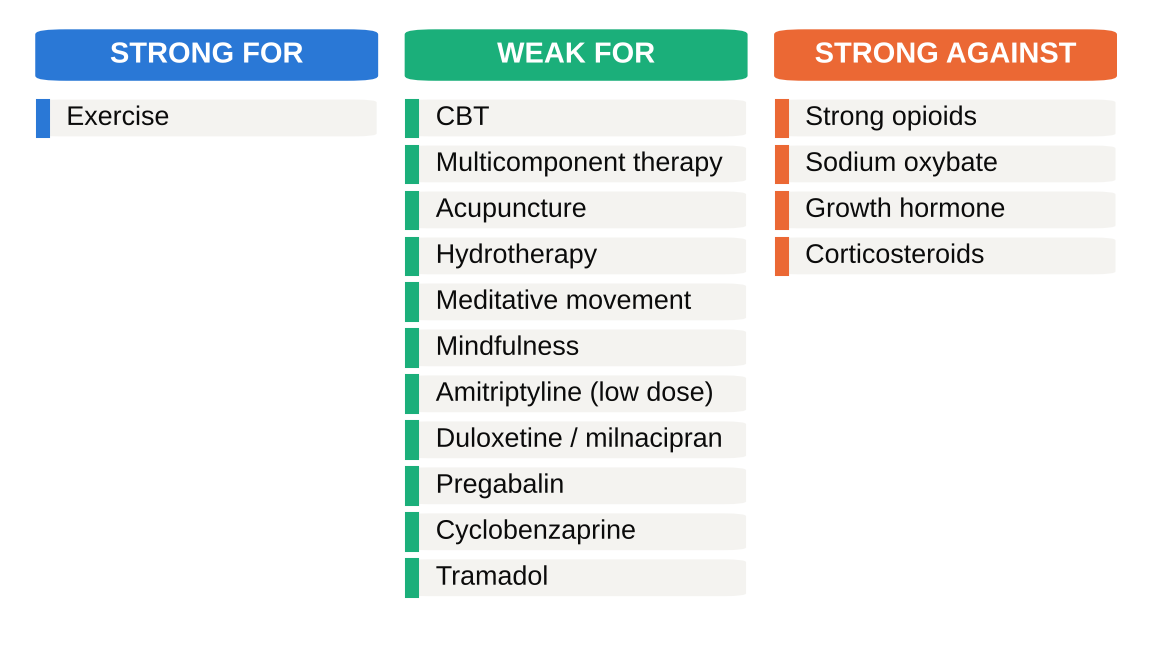
Opioids require caution. The revised European Alliance of Associations for Rheumatology (EULAR) recommendations give tramadol only a weak recommendation for selected patients and recommend strongly against strong opioids. At the same time, fibromyalgia commonly coexists with depression, anxiety, sleep disorders, and migraine. When several prescribers each treat one symptom, centrally acting and sedating medicines can accumulate without any single clinician reviewing the complete regimen.
What the Guidelines Actually Favor
The strongest guideline signal is not another medicine. In the EULAR recommendations, which graded evidence from 107 systematic reviews and meta-analyses, exercise was the only therapy to receive a strong recommendation in favor (Figure 2). Initial management centers on patient education and nonpharmacologic treatment. Psychological therapies such as cognitive behavioral therapy are added for patients with mood disorders or unhelpful coping, pharmacotherapy may be considered for severe pain or sleep disturbance, and multimodal rehabilitation may be considered for severe disability.
The Economic Burden Is Broader Than Pharmacy Spend
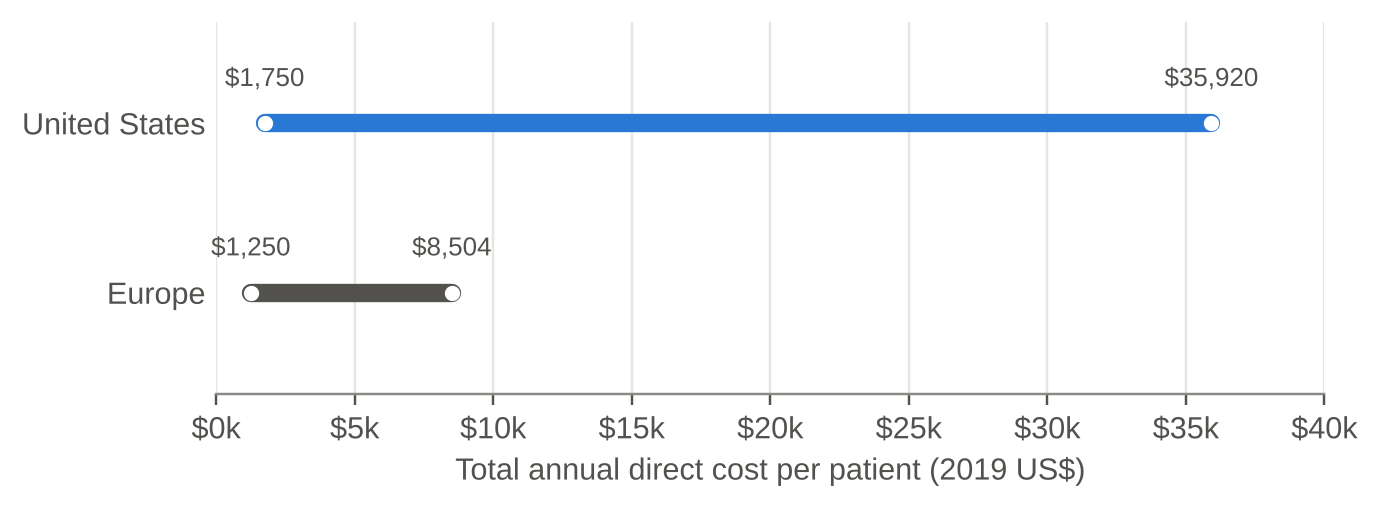
A 2022 systematic review of 36 cost-of-illness studies found wide variation in total annual direct costs per patient: from about $1,750 to $35,920 in the United States and from about $1,250 to $8,504 in Europe, after adjustment to 2019 US dollars (Figure 3). Medications were the largest contributor to direct costs in most included studies, and the review also documented substantial indirect costs from lost function and productivity. The studies differed substantially, and their overall risk of bias was high.
That distribution matters for program design. Reducing drug spending is not, by itself, the outcome that matters most. A useful service line should be judged by whether patients function better, whether ineffective medication is stopped appropriately, whether evidence-based nonpharmacologic care is delivered and whether avoidable utilization declines over time.
The Payment Mismatch
The evidence therefore points toward a care model built around exercise programming, education, behavioral health, longitudinal medication review, and care coordination. Each of these requires staff time and follow-up. Under fee-for-service payment, the funding for that work can be fragmented, with coverage and payment varying by payer and service. A prescription can fit an established payment pathway even when a coordinated care program lacks a reliable budget.
In my view, that creates a structural bias toward medication as the default intervention. Clinicians may know the evidence while lacking the infrastructure to offer exercise, behavioral support and follow-up consistently.
Reframing the financing question
For safety-net organizations, the useful question is not how to obtain fibromyalgia drugs more cheaply. Generic availability can help with drug costs, while the new branded option changes any assumption that the entire formulary is generic. Lower prices alone do not resolve the need for broader care. The useful question is how to finance the care model the evidence supports.
Do not model fibromyalgia solely as a drug-pricing problem or assume savings on its older generics can fund better care. Model the opportunity, where permissible, as a financing question for a broader service line that supports function-focused, evidence-based care. Part 2 of this series examines whether, and under what conditions, savings generated through the 340B Drug Pricing Program can help answer that question.