The data gap that slows the pace of physician credentialing
A license lookup does typically involves multiple data sources, and pulling information together on clinicians can take weeks.

A state medical board license lookup will confirm that a physician is licensed, active and free of public discipline. It will rarely confirm where they attended medical school, where they completed residency or where they hold hospital privileges.
That gap is not a website design flaw. It is the defining feature of how physician credentialing actually works in the United States, and it is one of the quieter reasons rural and underserved communities have the longest wait for physicians.
I saw this firsthand in reviewing two physicians I know personally through New Mexico's license verification system. Both are active, board certified and free of any disciplinary record. Neither their medical school nor their residency training appeared anywhere in the state database. Relying on that single source alone would leave any credentialing committee with an incomplete picture, even for two clinicians with strong, verifiable professional standing.
Credentialing involves at least six data sources
Primary source verification, the process every hospital and payer is required to complete before a physician can see a patient, means confirming each credential directly with the body that issued it.
Those include a state medical board; the National Practitioner Data Bank; a medical school registrar; a specialty board; a malpractice carrier. None of these systems were built to talk to each other, and each operates on its own timeline.
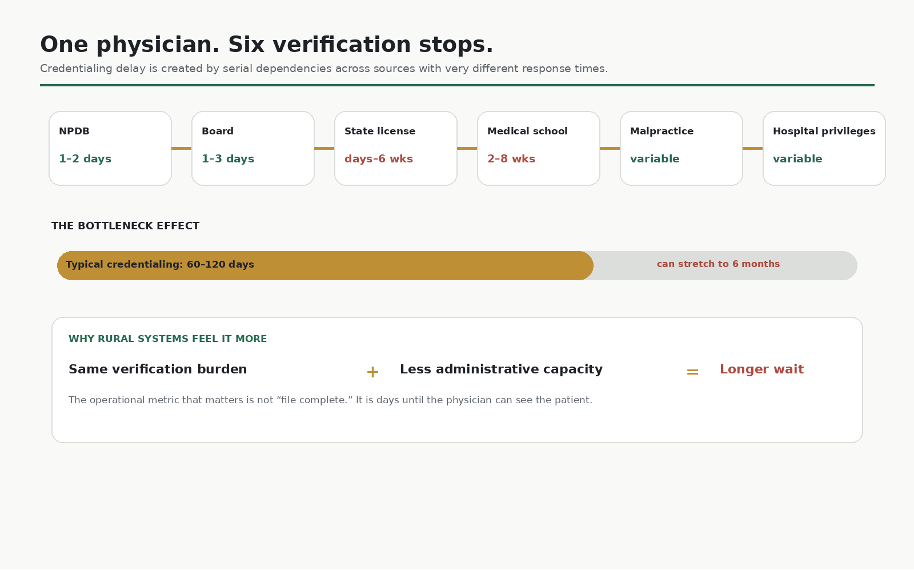
An NPDB query typically comes back in 24 to 48 hours. A specialty board verification takes one to three days. A state medical board can take from a few business days online to four to six weeks by paper. A medical school registrar, often the slowest link, can take two to eight weeks, depending entirely on how well staffed that office happens to be that week.
The National Practitioner Data Bank sits at the center of this system for a reason. Congress established it in 1986 to keep practitioners with a history of substandard care from moving state to state without disclosure. Federal law requires hospitals to query it on every physician holding clinical privileges at least once every two years.
The NPDB does an important job, but it was never meant to contain a complete record on all physicians. The operational problem is what happens around it: education, training, licensure, board status and privileges still live in separate systems with separate clocks.
The impact on rural and underserved communities
A credentialing file that takes 60 to 120 days to complete, which can stretch to six months when any single source is slow or a document is incomplete, is a manageable cost for a large health system with a dedicated credentialing department running dozens of files at once. It is a much bigger lift and expense for a critical access hospital trying to onboard the one family physician willing to relocate to a county that has gone without one for a year.
The federal government's own rural recruitment infrastructure recognizes this. Sites participating in the National Health Service Corps, the primary federal program steering primary care clinicians toward underserved areas, are required to run a credentialing process that includes, at minimum, reference checks, license verification and an NPDB query, on top of whatever their state and payer credentialing already demands.
A rural site with no dedicated credentialing staff runs the identical multi-source verification process as a large academic medical center, with a fraction of the capacity to chase down a slow registrar or resolve a development letter quickly.
Standards are tightening
The National Committee for Quality Assurance rolled out its most significant credentialing update in years in mid-2025, shortening the maximum primary source verification window from 180 to 120 days for accredited organizations and from 120 to 90 days for certified organizations, while also requiring monthly monitoring of license status, exclusions and board actions rather than the twice-yearly checks that were previously standard.
Faster windows and more frequent monitoring are a genuine improvement in patient safety oversight. They also raise the operational bar for the organizations least equipped to clear it. A tighter deadline does not close the gap between a well-resourced system and a small rural hospital. It makes the gap more consequential when it is not closed.
The real bottleneck is data stewardship
Credentialing delay is, at its core, a master data management failure. The same physician's identity, education, training and standing exist as separate, unlinked records across six or more systems, each with its own update cycle and no shared identifier tying them together.
A CAQH profile is a partial fix, a shared repository payers can pull from instead of re-collecting documents. It does not solve verification timing, because CAQH itself depends on the same slow upstream sources.
The full fix is a data stewardship function, which involves having one role accountable for the completeness and currency of a candidate's full credentialing record, tracking every open request against its expected response time. Large systems build this without necessarily naming it. Small and rural hospitals rarely have the staffing to build it at all, which is why shared regional infrastructure matters more for them than anyone else.
Priorities for healthcare executives
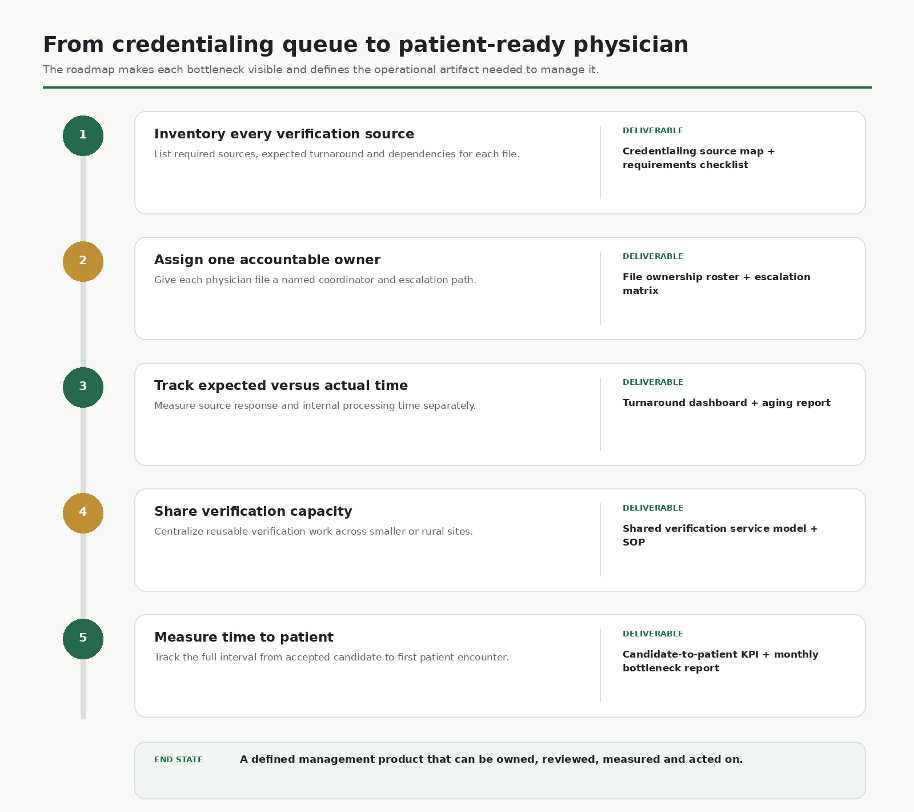
Immediately, organizations should run an NPDB self-query on every finalist before an offer letter goes out, not after acceptance. A dispute discovered post-offer can take months to resolve and stalls a hire that a rural or underserved site cannot afford to lose.
In the near term, organizations should consolidate every open credentialing file into a single CAQH-based system with one identified owner tracking response status across all six source types. The single biggest preventable delay is a request that no one follows up on until the deadline has already passed.
For a longer-term goal, organizations should evaluate a shared or regional credentials verification organization model for small and rural facilities that cannot justify a dedicated credentialing department alone. Pooling this administrative capacity across several small hospitals is often the only realistic way to match the speed of a large health system.
A physician's license, board certification and clean NPDB record confirm that they are qualified to practice. None of it confirms that a rural hospital can get them credentialed fast enough to actually start.
The next barrier in this series is not about verifying a physician who already exists. It is about whether that physician was ever trained close enough to a rural community to consider practicing there in the first place.
Julia Rehman, DHA, FACHE, FACHDM, is founder and chief operating officer of Kota Kompany LLC.