What the interstate Compact reveals about the rural telehealth gap
The Interstate Medical Licensure Compact provides a way to expedite licensure, showing this architectural solution can help.
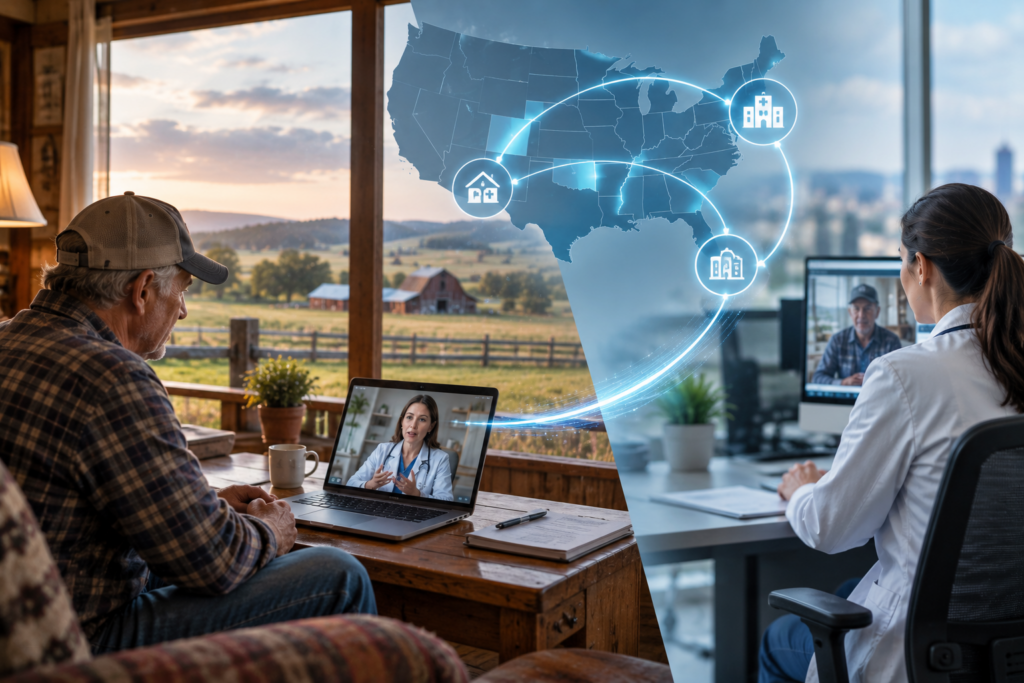
A fully credentialed physician, trained close enough to a rural community to want to practice there, still faces one more data barrier before treating a single patient across a state line. The receiving state must recognize his or her license.
Until recently, that meant starting the entire verification process over from nothing in every new state.
The Interstate Medical Licensure Compact was built specifically to close that gap, and its own data now offers a clear picture of how much progress that has actually bought rural and underserved patients, and how much distance remains.
What the Compact actually does
The Compact does not create a new type of license or a national license that works everywhere. A physician who qualifies still receives a full, individual license in each member state they select, identical in legal authority to a license obtained the traditional way.
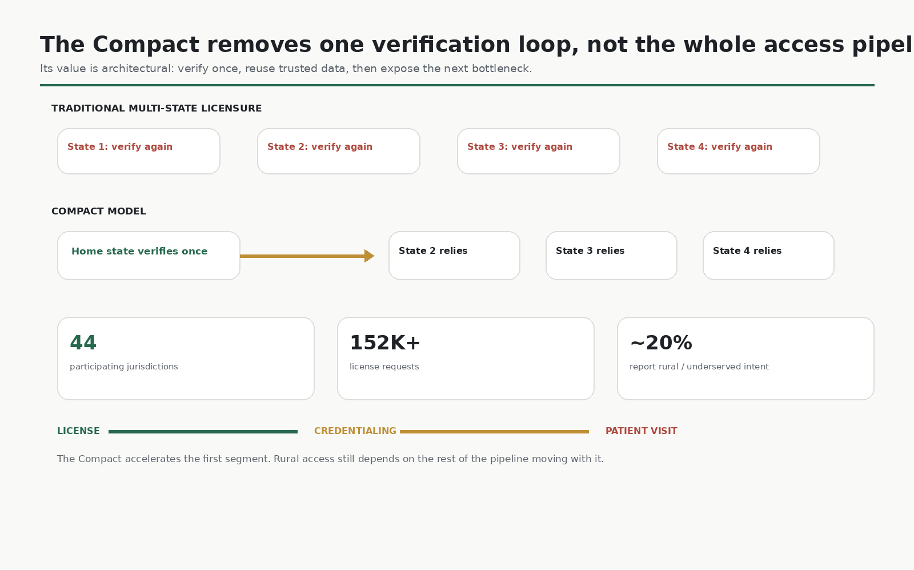
What changes is the verification process behind it. Instead of each state independently re-running primary source verification from scratch, a physician's home state confirms their qualifications once, and participating states rely on that confirmation to issue their own license on an expedited timeline.
That is a genuine data-sharing solution to a genuine data-verification problem. It does not eliminate state licensing authority, and it does not change a single state's underlying medical practice act. It changes who has to re-verify the same underlying facts.
Volume tells the adoption story
Between April 2017, when the Compact began accepting applications, and May 2025, it processed more than 95,000 letters of qualification and more than 152,000 individual license requests, with volume still climbing. May 2025 alone accounted for nearly 4,400 new license requests.
The average physician using the Compact receives four licenses through it, evidence this is overwhelmingly a tool for physicians who already intend to practice across multiple states.
Radiologists and pathologists interpreting studies across state lines, hospitalists and psychiatrists covering multiple facilities near state borders, and telemedicine physicians scaling a single practice regionally all disproportionately rely on it.
Where the gap still remains
Some 44 jurisdictions – 42 states plus the District of Columbia and Guam – now participate. That leaves a handful of states, including several that have passed legislation but have delayed implementation – where the faster pathway simply does not exist yet.
For a rural patient in one of those states, the telehealth specialist who could see them fastest may still be blocked by exactly the multi-state verification delay the Compact was built to solve everywhere else.
A regional research center tracking state-level telehealth licensure policy found that participation, and the rules states attach to it, shifted meaningfully around the COVID-19 public health emergency.
This underscores that this is not a settled landscape. It continues changing year over year, which means the access gap for patients in non-member states is not fixed either.
The rural intent is explicit and partial
Roughly one in five physicians using the Compact report doing so specifically to serve rural or underserved areas, and the Compact's own stated mission names rural access, alongside specialist reach and telehealth expansion, as a primary purpose.
A faster license solves one layer of access. It does not solve reimbursement, broadband, privileging or the hospital credentialing file waiting behind it. The useful executive measure is not time to license. It is time until the physician can actually see the patient.
The Compact's real innovation is not legal; it is architectural. A verified-once, trusted-everywhere data exchange model, where one state's primary source verification becomes a data asset that other states can rely on instead of reproducing. That is federated data sharing, the same underlying pattern health information exchanges use to let one hospital trust lab results generated at another without re-running the test.
The gap this series keeps surfacing is that the Compact solved federated data sharing for licensure while credentialing, one system over, still has not.
A hospital's own credentialing file cannot yet trust a Compact-verified license the way one state now trusts another state's verification, which means the data architecture problem this series opened with in Part I is still the bottleneck standing between a fast license and a physician actually seeing a patient.
Priorities for healthcare executives
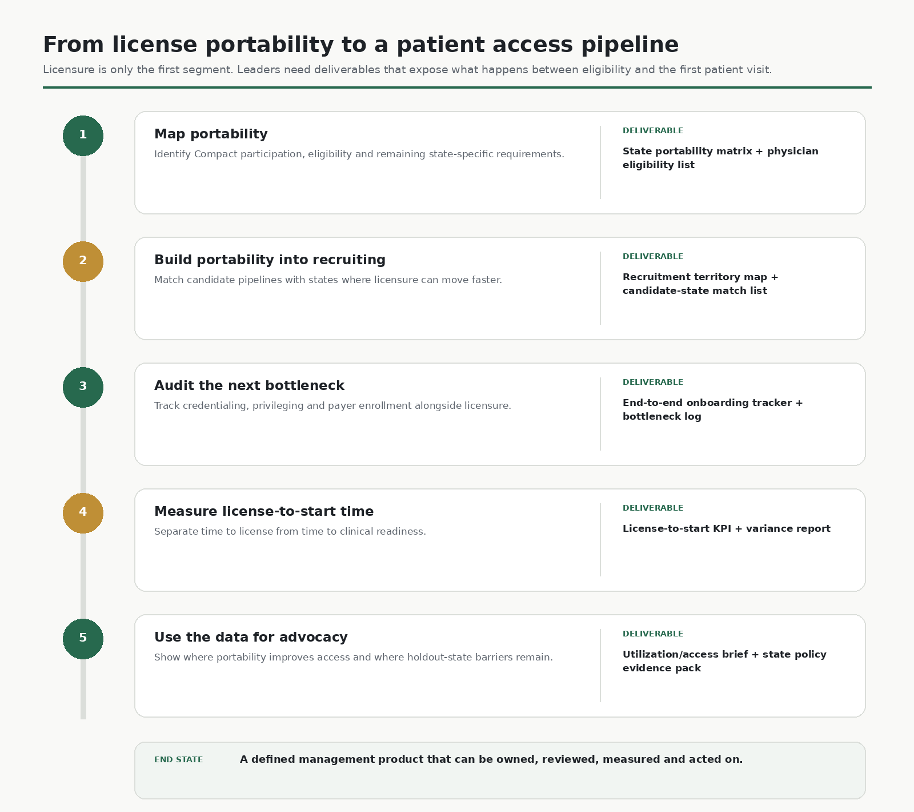
Immediately, organizations should audit which states your current or prospective recruiting pipeline effectively excludes because of non-Compact membership, and quantify the size of the rural or underserved patient population on the other side of that gap. Most systems have never run this analysis.
In the near-term, organizations should pair every Compact-based hire with an internal credentialing timeline audit before assuming the faster license translates into a faster start date. A physician can hold a valid license in a new state for weeks before an internal credentialing file catches up to it.
For the longer-term, organizations should use Compact utilization data, licenses issued, specialties represented, rural intent reported, as the evidence base for state-level advocacy in the remaining holdout states.
Data from a program already operating successfully in 44 jurisdictions is a stronger argument than a general appeal to access.
Across all three articles in this series, the pattern is the same one that shows up whenever healthcare administrators are responsible for a workforce pipeline they do not fully control. A physician must clear a credentialing process built on data scattered across sources that do not talk to each other.
They are more likely to want to practice in a rural or underserved community if their training happened to take place near one. And once qualified and willing, they still need a state to recognize what another state has already verified.
None of these three barriers is primarily about physician supply. Each one is about whether the data infrastructure behind that supply was built to move at the speed rural and underserved communities actually need. Closing any single gap helps. Closing all three – credentialing speed, training geography, and license portability – is what actually gets a physician in front of a patient who has been waiting.
Julia Rehman, DHA, FACHE, FACHDM, is founder and chief operating officer of Kota Kompany LLC.