
What residency data reveals about the rural physician shortage
While rural organizations struggle to find physicians to fill gaps, some opportunities exist to improve training and retention, backed by data-based evidence.

More than half of physicians who completed residency training between 2014 and 2023 are practicing today in the same state where they trained.
That single data point, tracked by the organization that accredits and coordinates the nation's medical schools, explains more about the rural physician shortage than any recruitment statistic a rural hospital could produce on its own.
The problem is not that this data does not exist. It is that graduate medical education capacity, the training pipeline that produces every practicing physician, is concentrated in the same urban academic medical centers that already have the least trouble recruiting.
Where you train predicts where you stay
The relationship holds at every level of specificity researchers have measured it. A 2026 scoping review in the journal Family Medicine confirmed what smaller studies have shown for years; graduates of rurally located residency programs practice in rural settings at meaningfully higher rates than physicians trained in urban programs.
The same review noted the vexing fact that buttresses that finding. Most physicians currently practicing in rural settings were still trained in urban places, because urban programs still produce the overwhelming majority of the physician workforce.
A separate peer-reviewed study of more than 12,000 family medicine residency graduates quantified the dose-response relationship directly, finding that more months of rural training exposure during residency was associated with a higher likelihood of eventual rural practice and with practicing in a more rural location once there.
Retention varies enormously by specialty
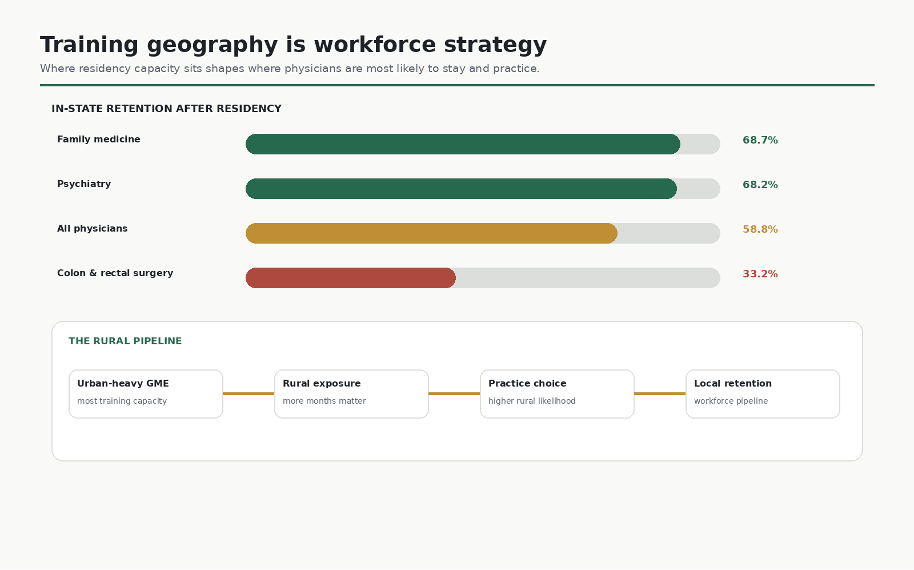
In-state retention after residency is not uniform. Among specialties with at least 500 practicing physicians in the national data set, family medicine retained 68.7 percent of its graduates in-state, followed closely by psychiatry at 68.2 percent.
Procedure-oriented specialties told a different story. Colon and rectal surgery retained only 33.2 percent of its graduates in the training state, the lowest of any specialty tracked.
That gap matters directly for rural workforce planning. The specialties rural communities most need locally, primary care and behavioral health, are also the specialties most likely to stay if a health system can get a resident trained nearby.
However, GME funding decisions are rarely made with retention data as an explicit input, which means the specialties best positioned to stay local are not necessarily the ones receiving the training investment their retention rates would justify.
A 25-year freeze partially thaws
The structural constraint behind all of this is federal funding. The number of residency positions Medicare will fund had been effectively frozen for nearly 25 years, creating a hard ceiling on how much GME capacity, rural or urban, the country could add regardless of demand.
Recent legislation lifted that cap for the first time in a generation, adding 1,000 new Medicare-supported positions split between rural and urban teaching hospitals, against a backdrop of a physician shortage projected to reach as much as 139,000 by 2033.
However, 1,000 new positions will not solve the national shortage. But for an individual health system, they create something much more practical, which is a limited chance to move training capacity closer to the communities that need physicians and are more likely to keep them.
What the accrediting body is building
The Accreditation Council for Graduate Medical Education maintains an active Rural and Underserved GME initiative, specifically because the evidence on training location and retention is strong enough to justify structural investment, not just individual program goodwill.
Its own published research base spans obstetrics rotations in community health centers, teaching health center placements concentrated in federally designated underserved areas and free clinic continuity experiences shown to predict later practice in underserved settings.
The infrastructure to build more of this already exists. What remains scarce is deliberate investment by academic medical centers willing to treat rural training exposure as a core part of program design rather than an elective rotation.
Turn retention data into workforce strategy
Workforce planning at most academic medical centers stops the moment a resident graduates, because no one owns the data pipeline connecting a training record to a practice-location record years later. That is a longitudinal data linkage problem, the same discipline that lets a health system track a patient's outcomes years after a single encounter.
AAMC and ACGME already collect and publish the underlying data. What is missing at the institutional level is the analytics function that pulls it into a program's own workforce planning, rather than treating national statistics as background context that never gets applied locally.
Building that function does not require new data collection. It requires a data governance decision, requiring the assignment of someone to actually connect a program's own graduate outcomes to national retention benchmarks, on a recurring basis, and feeding that comparison directly into decisions about which rotations to fund and expand.
Priorities for healthcare executives
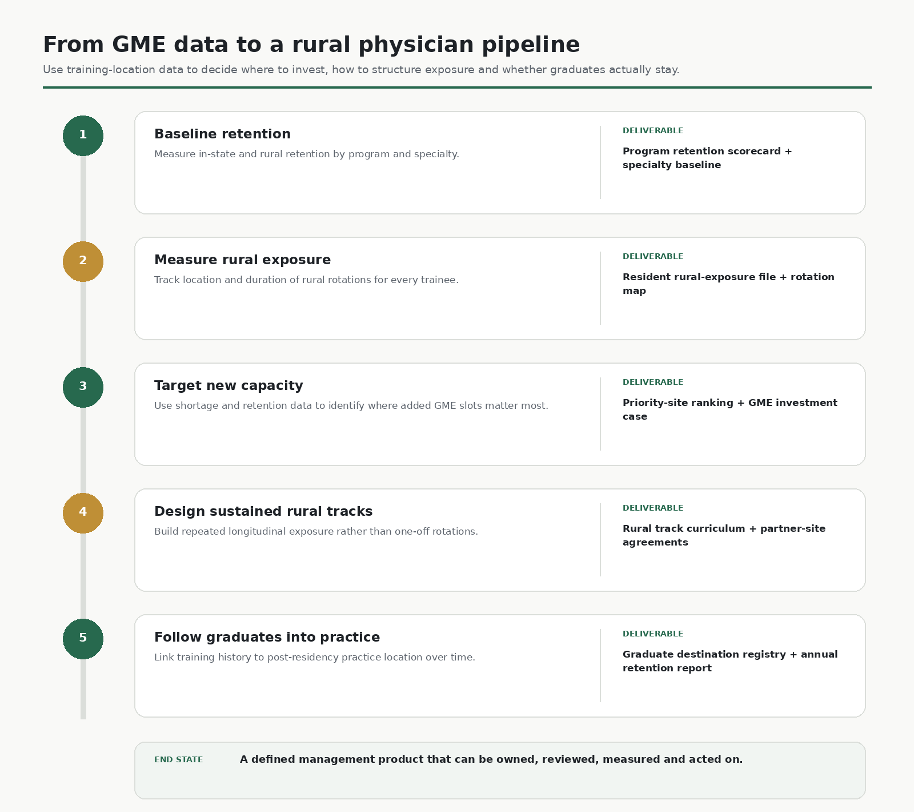
There are plenty of action steps for executives to act upon.
Immediate: Pull your own residency program's in-state and in-region retention data by specialty and compare it with the national benchmarks in this article. A program tracking retention only in aggregate is missing the specialty-level variation that actually drives workforce planning.
Near-term: Apply specifically for a share of the newly uncapped Medicare-funded GME positions earmarked for rural placement. This opportunity will not reopen on any predictable timeline, and competing for it now matters more than waiting for a larger future expansion that history suggests may not come for another generation.
Longer-term: Redesign rural rotations as a structured, required component of residency curricula rather than an elective. The evidence is consistent that duration of rural exposure, not simple exposure, predicts eventual rural practice, which means a two-week elective will do far less than a sustained, multi-month rural training track.
A pipeline problem, not a recruiting campaign
A rural hospital can win every recruiting battle it fights and still lose the war, if the pipeline feeding it new physicians was never built to run through rural places to begin with. Fixing recruitment without fixing training geography treats a structural problem as a marketing problem.
Even a physician trained in the right place, credentialed correctly and willing to relocate still faces one more data barrier before they can see a patient -- whether the state where that patient lives will recognize a license issued somewhere else. That is where this series turns next.
Julia Rehman, DHA, FACHE, FACHDM, is founder and chief operating officer of Kota Kompany LLC.